
What 400+ Catholic leaders discovered when they stopped asking how the Church could serve families—and started asking what the Church could learn from them.
Michelle Sutton’s young family gathers for a celebration, but there are no presents to open.
A candle is lit, but it is not a birthday.
Instead, they are celebrating a different beginning: the anniversary of their daughter’s baptism.
Together, they remember the day she was welcomed into the family of God, renew the baptismal promises first made on her behalf, and celebrate her call to carry the light of Christ into the world. “The symposium helped me realize that my children’s baptismal anniversaries should be remembered and celebrated just as intentionally as their birthdays” Michelle shared.
This tradition is new for Michelle, Catholic Leadership Institute’s Chief of Staff. It was inspired by the 2025-2026 Virtual Symposia on family faith formation and children’s catechesis in the Church. Across three sessions, over 400 Catholic leaders participated from across North America, including bishops, priests, religious sisters, parents, educators, parish and diocesan leaders, and representatives of Catholic ministries and apostolates.
Sparked by the desire to know how to pass on a faith toa generation steeped in secular culture and beliefs, the symposia examined the realities facing families, the spiritual capacity of children, and the parish cultures needed to form lifelong disciples.
The insights and learnings of these conversations are shared with the Church in our newly released whitepaper: Raising Disciples in an Apostolic Age: Charting a New Path for Family Faith Formation. It is a call to action and hope—a recovery of the fundamentals of forming disciples in the home, a renewed understanding of the role of the family and the child in the Church, and a recognition that faith can still be transmitted with abundant fruit in our modern world.
WE MUST ADOPT A NEW MINDSET
Today, amid social and financial pressures, competing priorities, changing household structures, and cultural narratives that often treat religious belief as optional, families must intentionally choose faith.
At the same time, many parents are exhausted, feel unequipped to share the faith, or have never been formed as disciples themselves. Yet rather than seeing parents as disciples to be formed and essential partners in forming their children, parish systems often treat parents primarily as drivers, volunteers, tuition payers, or enforcers of attendance requirements. One participant resolved, “I want to release the desire to hold on to the way we have ‘always’ done things because it is easy and safe.”
The whitepaper points to one such mindset shift: Parents need initiation as much as instruction. Before they can confidently form their children, they need opportunities to encounter Christ, deepen their own faith, and walk alongside others.
Families do not simply need more information or another program. They need communities that know them, listen to them, and accompany them through the changing stages of family life.
CHILDREN ARE DISCIPLES NOW
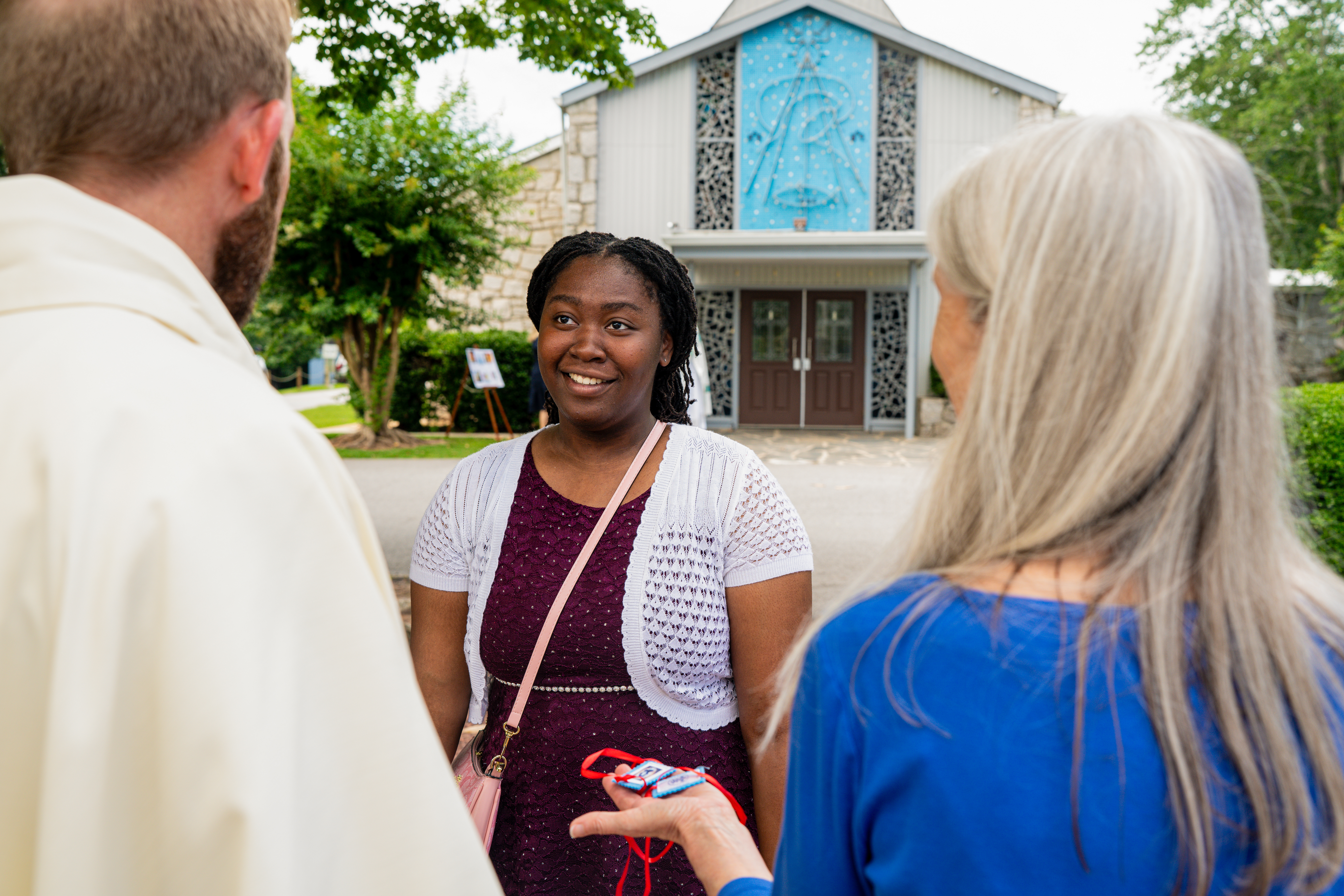
Another compelling insight concerns the place of children in the Church. Children are often described as the “future of the Church.” Our participants challenged that framing and acknowledged that children are not simply future disciples; they are disciples today, and they belong today—right now, as children.
Children were named as liturgical participants, spiritual knowers, and witnesses who naturally perceive mystery, enter silence, respond to beauty, ask profound theological questions, and demonstrate an authentic trust in God. Their faith frequently draws parents and grandparents back to Mass, the sacraments, and parish life with one participant noting: “I’ve observed children who have fallen in love with God bring their parents back to the Church. Their love of God is beautiful and contagious.”
The Church’s task, then, is not merely to make adult religious instruction more entertaining for children. It is to know children well enough to recognize how they encounter God at each stage of development—and to receive the gifts they already offer.
THE FAMILY AS A CATALYST FOR RENEWAL
Perhaps the whitepaper’s most significant insight is how we understand family ministry in today’s secular culture—as not merely one group within the parish requiring specialized services. They are a lens through which the parish can learn to become a healthier Church.
Families quickly reveal whether parish communication is clear, expectations are realistic, relationships are genuine, spaces are welcoming, and support is available. In the same way, children reveal whether a parish actually believes its own theology. The questions that apply to honoring the child in the Church serve as a litmus test to discover whether or not the parish believes that baptism is a gift, that discipleship is universal, that every member has gifts, and that the Church is a family. If a parish cannot make room or meet a five-year-old in his or her faith journey, the parish likely struggles to make room for others.
When parishes turn their attention to the family, they turn their attention to the whole Body of Christ. In this way, the family is like leaven in the life of the Church: strengthening and renewing the whole community from within.
CLI Leadership Consultant Kate Sullivan expressed her own personal experience: “I may come to catechize, but I have the opportunity to be formed by the young people and families I am accompanying.”
How do we bring these learnings into practice? The whitepaper is written to bring the learnings of these conversations to light and to help leaders begin to bring about this mindset shift in their own dioceses, parishes, and families.
Your voice matters in this conversation. We encourage you to download the whitepaper and bring it to your community so that you can identify what forming lifelong disciples in modern times means for your parish. The download also includes a Parish Life for the Family Assessment that is designed to help you determine areas of strength and growth in your community and provide creative ideas for putting these learnings into practice.

Our Board Member Daniel Cellucci's weekly email, the DIAL: Discerning Insights About Leadership.
CLI serves Church leaders, helping them rediscover their potential and forming them to be more intentional with those they serve.
CLI helps empower and energize Catholic leaders by providing focus and courage to engage the culture with an apostolic mindset.
News and updates from Catholic Leadership Institute that highlight announcements within the organization, our team, or our partners.